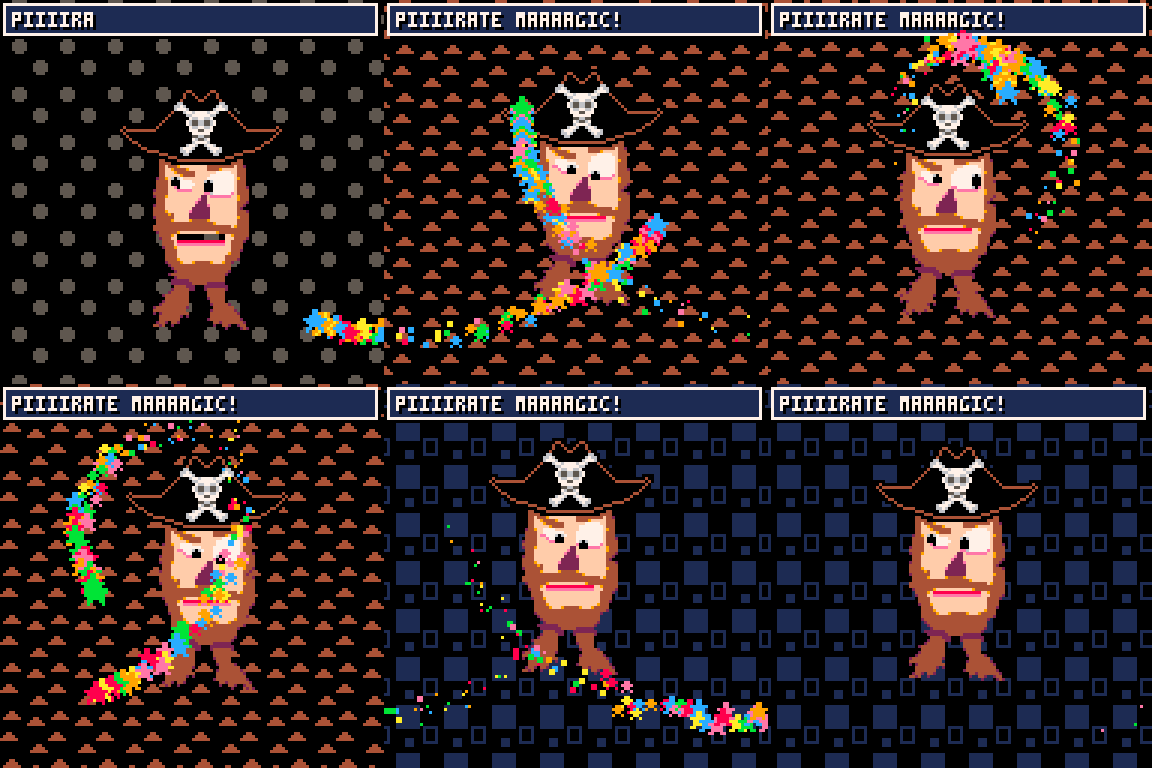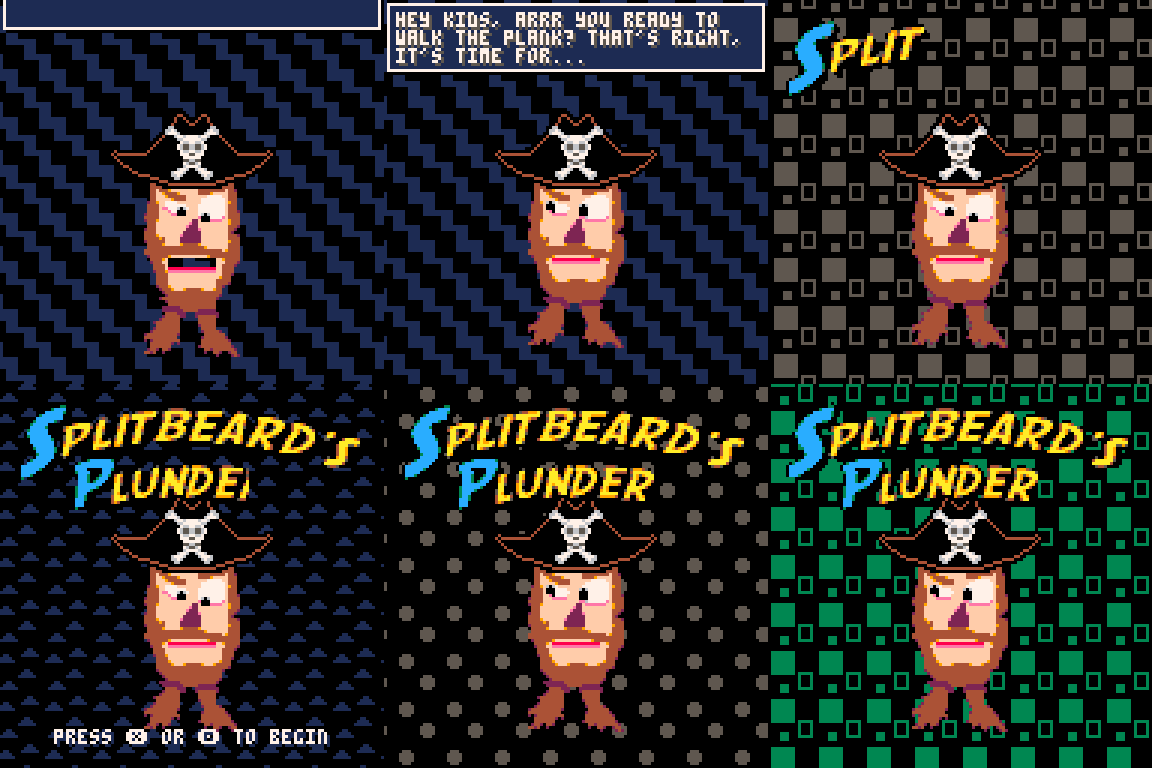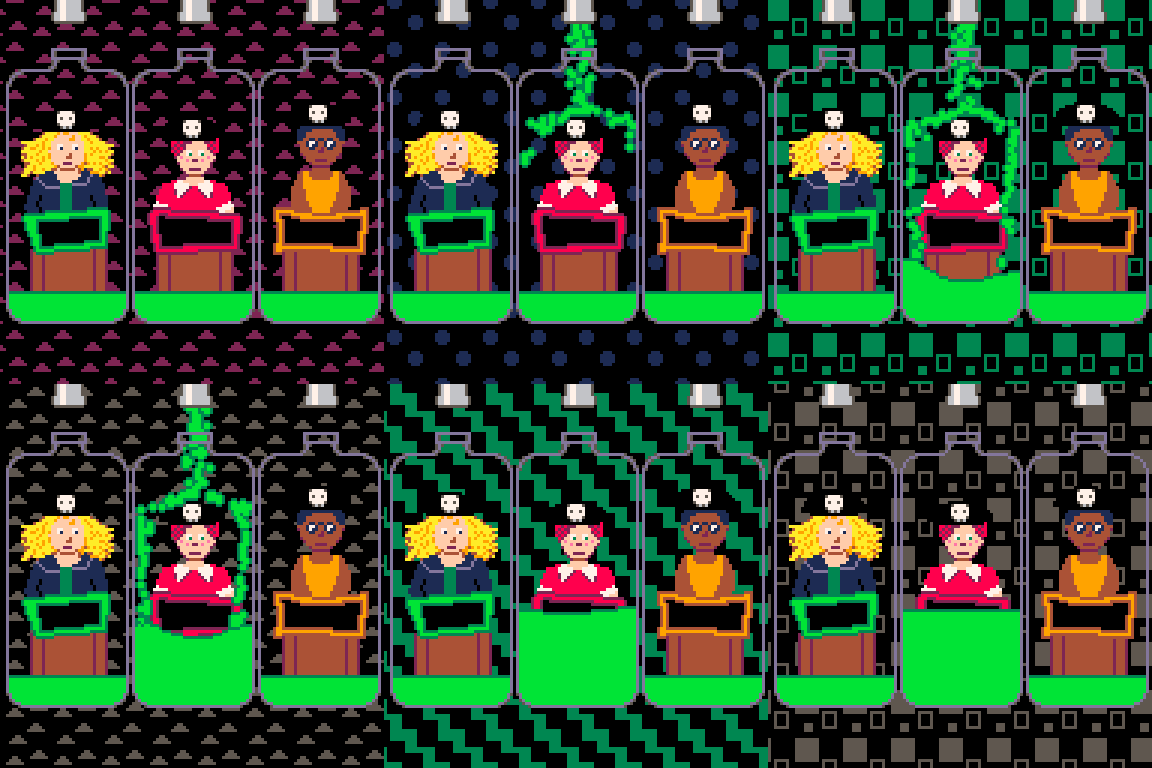




Finally, it's time for... Split! Beard's! Plunder!
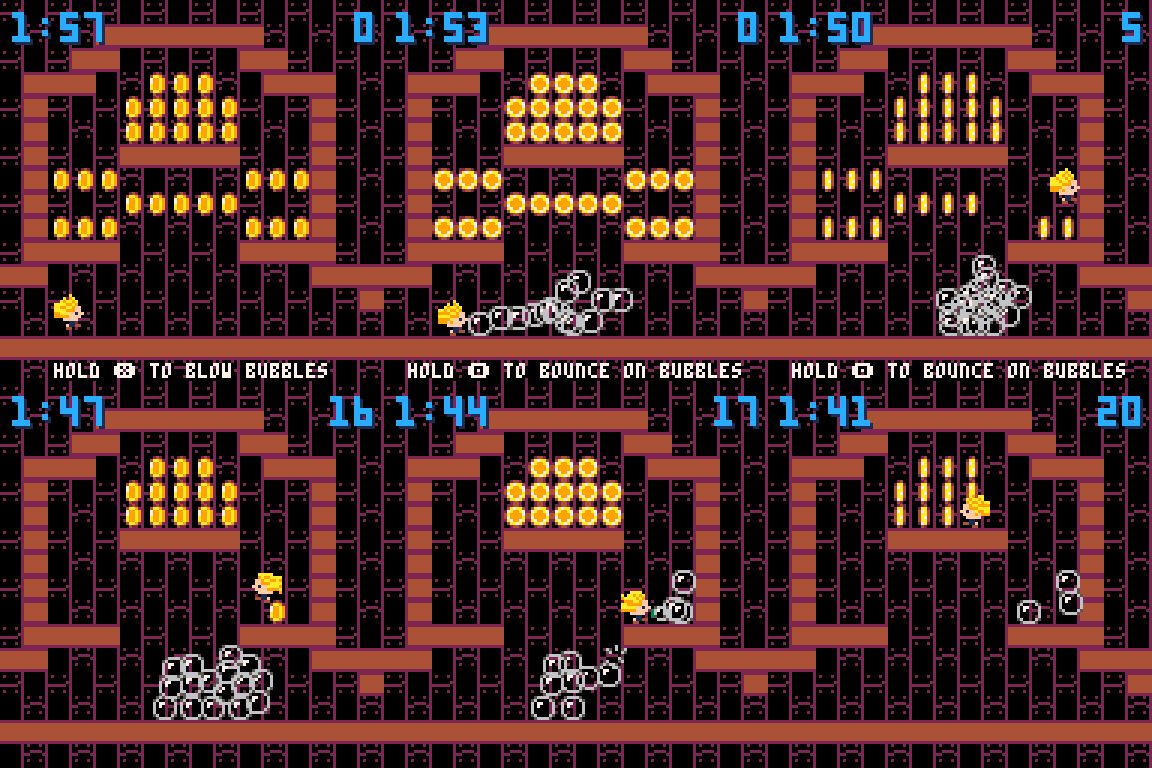


I wanted to do something less technically challenging this year because I wanted it to not eat up my life like it has the past two years, but mostly the result is that the difficult part changed from being programming to being writing and design. *shrug emoji*
I've got the show introduction implemented, and the quiz show part, and one of the physical challenges. I'm at 4261 tokens and I'm pretty nervous about implementing the rest of the game in the remaining space. I've got a fairly ambitious gameplay idea for the final physical challenge that I expect to take up a bunch of tokens, and all my ideas for what to do for an ending are token-heavy as well.
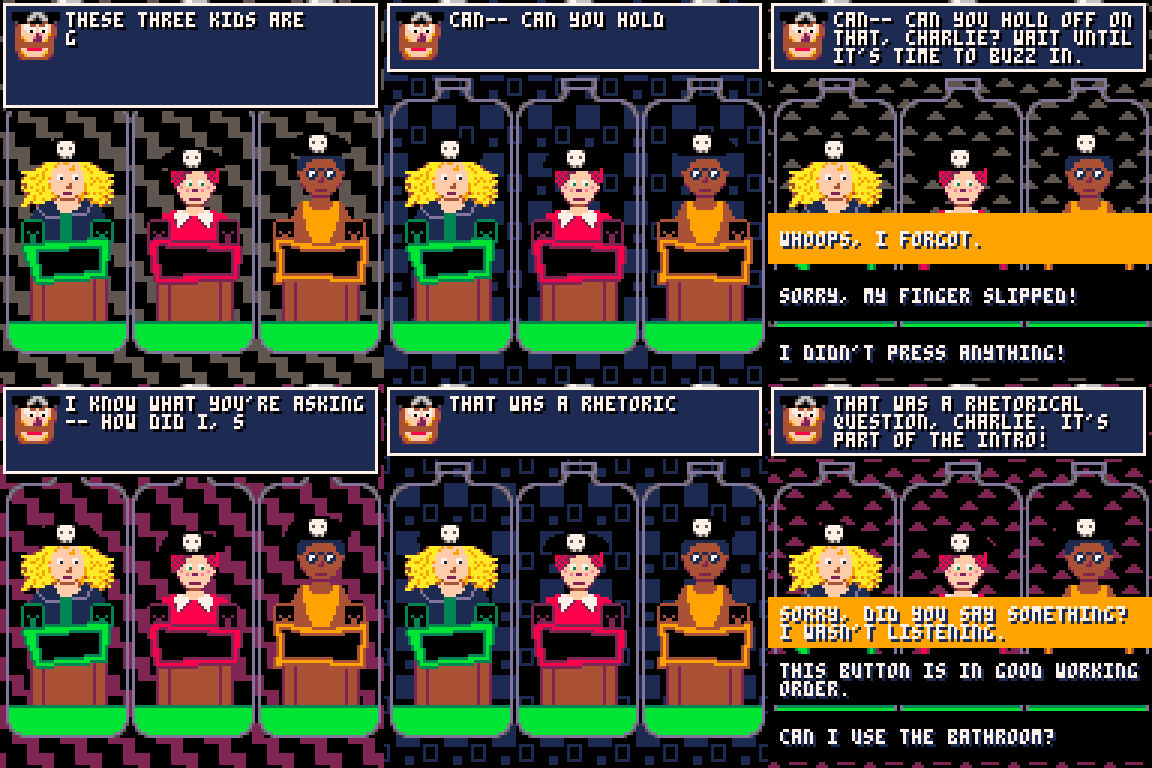
Wrote up some design notes/thoughts about design process here: /__site/twinbeard.itch.io/it2/devlog/1137791/it-2-design-notes
As you golf tokens to add features, the code complexity increases and the compressed code size goes up. It's the Token Golfer's Curse. I forgot to keep counting, but I'm at something like 1500 tokens golfed and I've been actually having to remove features/text to make new things fit.
I've spent the past couple of days implementing audio and music -- not very screenshottable -- and a secret ending --extremely screenshottable, except that I don't want to spoil it.
Anyway, please look forward to those things.
Yeah I'm of two minds about it as well. I think the token constraint is a crucial aspect of Pico-8's design. It discourages feature creep and encourages a shipping mentality. But when you're at the token limit and you need to fix a bug or make a tweak, there's nothing stopping you from golfing just a few more tokens, until your code is an unmaintainable mess and and you realize that if you do it wrong, Pico-8 is actually harder and less fun to use than an ordinary game engine.
I am butting up hard against both the token and compressed code limits right now, 99.85% and 99.79%, respectively. About 1300 tokens golfed. I don't know why I assumed this game would be simpler than my previous PiCoSteveMo entry! (I'm at like 86% for sprite/map space, despite having fleshed out the map far beyond what I'd predicted would be feasible. Apparently this game's level design compresses really well.)
Pico-8 token golfing is a deep rabbit hole.
A lot of token golf optimizations are just good changes, taking unnecessary complexity or verbosity and turning into it something simple. For example, in the initializer, I looped over the map, with a series of if-then statements to compare each map tile to a dozen different magic numbers that indicated a certain entity is supposed to spawn there, like this:
if t==1 then e = balloon(p) elseif t==4 then e = boulder(p) elseif t==20 then e = phone(p)
I have a function that initializes a dictionary using a string, so I created a tile to object mapping:
objs = dict"1,balloon,4,boulder,20,phone,37,target,34,stormdrain,39,checkpoint,2,button,48,gate,52,theythem,78,button"
So most of that series of if-thens gets replaced with this code that looks up the that object's initialization function in the global namespace dictionary:
if objs[t] then e = _ENV[objs[t]](p)
And I think that's a net good change, sacrificing simplicity for size and flexibility -- though the "actually good code" version would initialize the dictionary in a more readable way. But if you want to really get the most out of your tokens, you get up to some wild shenanigans. For example, I've got this code as part of the routine that draws the title screen, several calls to the sprite blitting routine specifying what to draw where:
cspr(256,78,0,3,2) cspr(259,110,0,2,2) cspr(261,4,20,8,2) cspr(288,68,20,7,2)
By Pico-8's count, that's 28 tokens. I added a wrapper to cspr that allows you to pass parameters in a string:
csprs"256,78,0,3,2" csprs"259,110,0,2,2" csprs"261,4,20,8,2" csprs"288,68,20,7,2"
Which is apparently valid function call syntax?? And a mere 8 tokens.
One of the most recent things I did was to take all the state of the dialog tree system that used to be encapsulated inside its own object, and just dump it into the global namespace. This saved like 50 tokens throughout the codebase because nar_msg is one fewer token than nar.msg.
This is by far the ugliest code base of any of my Pico-8 games. Historically I've avoided using a minifier because I like to ship a relatively readable game, but even with manual optimization, readability is totally out the window at this point. For my next game I'm probably going to figure out how to use a minifier workflow so things stay readable on my end at least.
I'd based my decision to switch from high memory video mapping to sprite caching on tests I ran where I disabled video remapping, and the same seemed to play fine. (Just with the wrong graphics.) After I actually did the switchover to sprite caching, and it still froze up, I revisited the no-remapping build and it also froze up. All three builds froze, after an unpredictable amount of time -- sometimes several minutes of gameplay.
In a shocking turn of events, the preceding investigation turned out to be a wild goose chase. The bug was happening when you input a diagonal rather than up/down/left/right, which is much easier to do accidentally on a touchscreen or d-pad than on a keyboard.
On the plus side, I get to keep all the tokens that I golfed to make room for the sprite caching library. ~1100 tokens golfed so far!